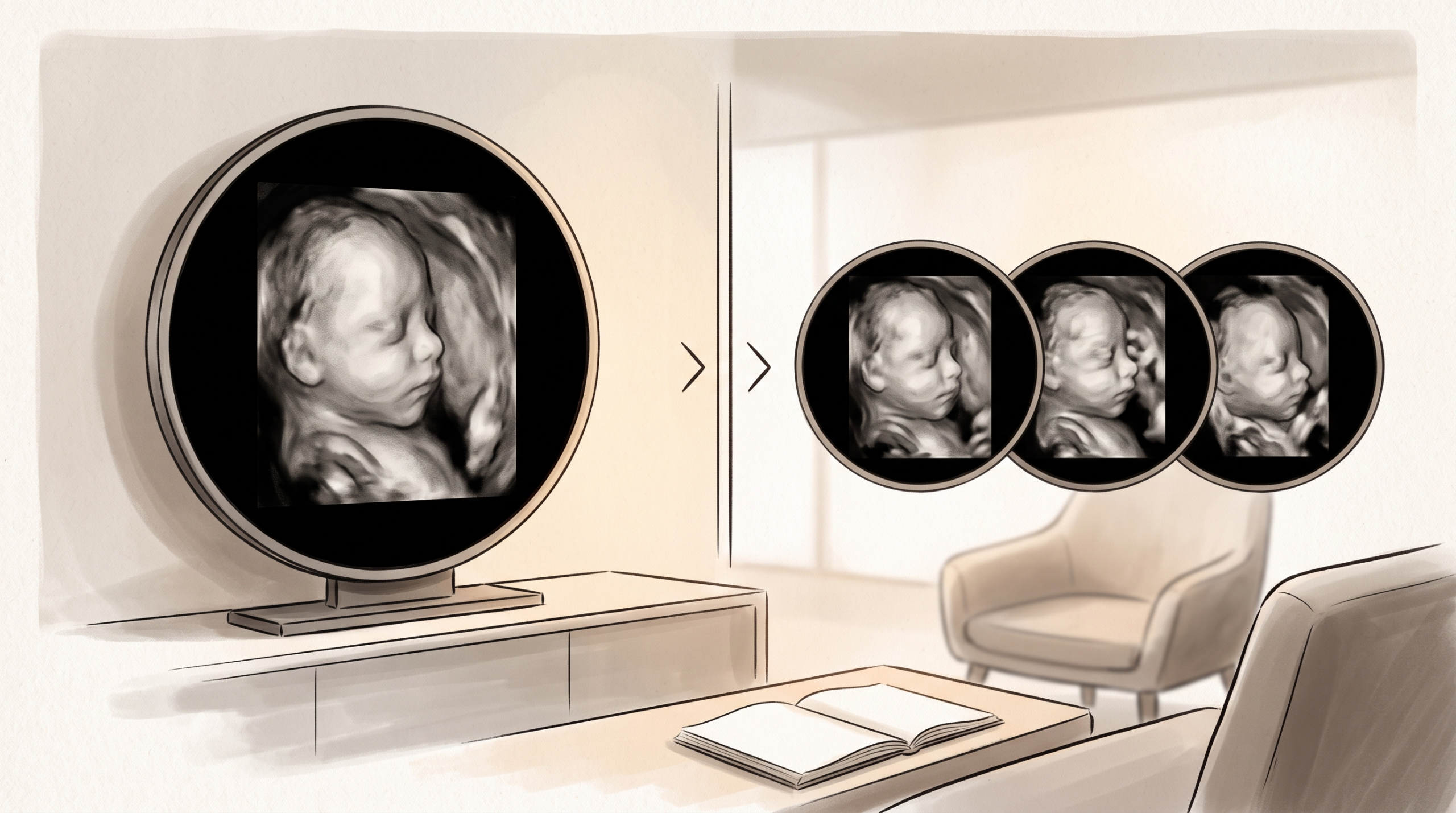
How to Compare 4D and 3D Ultrasound Before Booking
How to Compare 4D and 3D Ultrasound Before Booking
Short answer: 3D ultrasound creates a three-dimensional still view from ultrasound data, while 4D ultrasound displays a sequence of 3D views over time—3D in motion. Image quality in either format depends on fetal position, gestational stage, fluid, tissue and technical factors. Neither label tells you whether a session is medically indicated or diagnostic. Discuss pregnancy imaging with your health-care provider and use ultrasound prudently with trained personnel.

The comparison in five points
- 3D is primarily a volumetric still; 4D adds real-time or near-real-time motion.
- Both are produced with ultrasound, not photographs.
- Position and imaging conditions affect what can be seen.
- A keepsake session is not a replacement for prenatal diagnostic care.
- Questions about health, growth or anatomy belong with the responsible health-care provider.
Which format fits the result you want?
Choose between 3D and 4D by starting with the output, not with an assumption that one is a higher level of care. A family interested mainly in a rendered still may prioritize 3D images. A family that values visible movement may prefer a package that includes 4D clips. When both are offered, ask whether the session includes live viewing, delivered files, selected stills or a combination.
The comparison only becomes useful after the studio explains the session’s purpose and limits. Keep every medically recommended appointment, bring health questions to the prenatal care team, and treat a commercial session as optional rather than as evidence about the pregnancy.
- Choose 3D output when the primary goal is a selected volumetric still.
- Choose 4D output when seeing motion or receiving clips matters more.
- Compare both when package inclusions, file delivery and limited-view policies differ.
- Pause the booking when the provider blurs keepsake viewing with diagnosis or guarantees a result.
The plain-language difference
The U.S. Food and Drug Administration’s ultrasound guidance describes three-dimensional fetal ultrasound as a way to visualize some facial features and other parts, and says four-dimensional ultrasound is 3D ultrasound in motion. In practical terms:
- 2D ultrasound displays flat cross-sectional images and is foundational in medical imaging.
- 3D ultrasound reconstructs ultrasound information into a volume that can be viewed as a still.
- 4D ultrasound presents changing 3D volumes over time so movement can be viewed.
“HD,” “5D” and “8K” may be vendor or processing labels rather than separate medical dimensions. Ask exactly what the term means, what equipment or rendering it describes and what files the family receives.
3D and 4D at a glance
| Question | 3D ultrasound | 4D ultrasound |
|---|---|---|
| Primary output | Volumetric still view | 3D views shown over time |
| Useful for families comparing packages | Rendered still images | Movement clips plus selected stills where offered |
| Depends on fetal position | Yes | Yes |
| Automatically diagnostic | No; purpose and provider determine the exam | No; purpose and provider determine the exam |
| Replaces routine prenatal imaging | No | No |
| Guaranteed face view | No | No |

Start by separating medical imaging from a commercial package
Diagnostic prenatal ultrasound is ordered or performed to answer clinical questions and is interpreted within medical care. A commercial bonding or keepsake session has a different purpose. A package name, trained operator claim or realistic rendering does not by itself turn a commercial session into a diagnostic exam.
Health Canada’s medical ultrasound guidance says diagnostic ultrasound is a powerful non-invasive medical tool and should be used only when medically indicated by trained personnel. Its current guidance discourages fetal ultrasound used solely to create keepsake images or videos because there is no medical benefit and exposure duration and technique may not be clinically controlled. Prospective clients should read that guidance and discuss any concerns with their own health-care provider.
This distinction belongs near the booking decision, not hidden in a footer. The article should not claim that a keepsake scan checks development, growth, anatomy, health or “accurate results” unless the actual regulated clinical service and responsible practitioner support those statements.
Where each type belongs in the pregnancy care path
A standard prenatal ultrasound is part of medical care when ordered or performed for a clinical purpose. Specialized techniques may be used when a health-care professional needs particular information. A commercial 3D/4D package may be marketed as a bonding experience, but it should sit outside—not compete with—the medical care plan.
Before booking, keep the medical appointment schedule set by the prenatal team. If a clinic, hospital or regulated provider supplies 3D images during a medically indicated examination, those images are part of that care context. If a separate studio offers additional imaging, ask the prenatal provider whether there is any reason not to proceed and bring questions about symptoms or development back to the clinical team.
Qualification language needs scope, not adjectives
“Experienced,” “licensed” and “certified” are incomplete without the profession, jurisdiction, current status and scope. A public page should state who performs the session, which regulator or credential applies, whether a physician or other authorized professional interprets anything, and what happens when an unexpected image appears.
For a consolidation review, request:
- the legal business and professional names;
- current registration or licence evidence and verification path;
- the written diagnostic or non-diagnostic scope;
- medical oversight and referral procedures, if any;
- training and quality-assurance records appropriate to the service;
- privacy, consent and records policies;
- device licensing and maintenance documentation.
Do not publish a licence number or professional title until it is confirmed directly with the issuing authority and approved by the owner.
What affects the images
No studio can guarantee a specific face, expression or movement. 3D Baby’s current FAQ lists several image factors and also contains promotional claims that require medical and regulatory review before reuse. Visibility can be affected by:
- the fetus’s position and movement;
- hands, feet, cord or placenta near the area;
- gestational stage and available space;
- amniotic fluid distribution;
- maternal tissue and scar factors;
- equipment, settings and operator technique;
- the purpose and duration of the examination.
A studio may publish general scheduling suggestions, but the best timing is not a universal medical rule and can differ by pregnancy and goal. Ask the health-care provider about medically indicated imaging and ask the studio what its current non-diagnostic package policy says when images are limited.
Questions to ask before booking
- Is this session diagnostic, non-diagnostic or keepsake, and where is that stated?
- Who performs the ultrasound and what current qualification applies?
- Who interprets findings, if interpretation is part of the service?
- What does the session not assess?
- What is the planned duration, and how is prudent exposure handled?
- Which format is included: 2D, 3D stills, 4D clips or processed renderings?
- What files, prints or recordings are delivered?
- What happens if position prevents the desired view?
- How are images and personal health information stored and shared?
- What should a client do if a concern appears or symptoms develop?
When to contact your health-care provider
A commercial article must not triage pregnancy symptoms. Contact the responsible prenatal care team about health, growth, movement, pain, bleeding, fluid leakage or any other concern. Follow urgent-care advice already provided for the pregnancy. Do not delay medical assessment while waiting for a keepsake appointment or use a commercial image as reassurance.
How to compare package language
| Package term | Clarifying question |
|---|---|
| 3D images | How many selected still files or prints are included? |
| 4D video | Is it a live viewing experience, delivered clip, or both? |
| HD/realistic rendering | What processing or display does this label describe? |
| Heartbeat | Is listening or recording included, for what purpose and under whose protocol? |
| Gender assessment | Is it clinical or non-diagnostic, and what limitations and follow-up apply? |
| Rescan policy | When is another session offered, and what is excluded? |
| Licensed staff | Which licence or registration, verified where, and what scope does it cover? |
Prices, package contents, locations, schedules, credentials and policies can change. Verify them on the live booking page and in written confirmation rather than preserving them as evergreen facts.
Privacy and family sharing
Ultrasound files can contain names, dates, facility details and other personal information. Ask how the studio labels, transfers, retains and deletes images; whether portals or download links expire; and who can access the session. Decide before the appointment whether images may be used in marketing or social media. Consent for care or service should not be treated as automatic permission for promotional use.
If family joins remotely or in person, confirm occupancy, recording and device rules. Protect the pregnant person’s choice about who attends and what is shared.
Use a five-part decision before choosing
- Confirm purpose. Ask whether the appointment is expressly non-diagnostic or part of regulated medical care.
- Name the desired output. Decide whether still images, motion clips or a shared live-viewing experience matters most.
- Check limitations. Read what affects visibility and what the current policy says when a desired view is unavailable.
- Verify the package. Confirm the location, session duration, files, delivery method, guest rules and privacy terms in writing.
- Protect the care boundary. Keep clinical questions and medically indicated imaging with the responsible health-care provider.
This sequence is more reliable than choosing by a vendor label alone. Terms such as HD, 5D or 8K can describe presentation or processing, but they do not independently establish medical purpose, accuracy or safety.
What to verify with 3D Baby before booking
3D Baby’s owned pages describe 3D, 4D and HD live viewing and provide an online appointment path. Because packages and location details can change, review the current booking route and the page for the location you intend to visit. Confirm the exact format, deliverables, guest policy, accessibility, limited-view policy and privacy terms before payment.
Do not rely on an unverified phone number, a search snippet or an older article for credentials, scan totals, accuracy, locations or health-related claims. Ask the business for current written information and direct medical questions to the prenatal care team.
Common comparison mistakes
- Calling 4D a safer or more accurate version of 3D without evidence.
- Presenting a keepsake session as prenatal medical care.
- Guaranteeing a face view, expression or movement.
- Using “HD,” “5D” or “8K” without explaining the vendor term.
- Publishing a universal ideal week as medical advice.
- Repeating scan counts, accuracy rates or credentials without documentation.
- Hiding non-diagnostic limitations below the sales CTA.
- Failing to explain what files and privacy terms apply.
- Using realistic rendering as evidence of health or development.
3D and 4D ultrasound questions
Is 4D ultrasound better than 3D?
It adds motion to 3D views. “Better” depends on the legitimate purpose, needed output and clinical context; it is not automatically more diagnostic.
Does ultrasound use radiation?
Ultrasound uses sound waves and is not ionizing radiation. Health authorities still recommend prudent, medically indicated use by trained personnel.
Can 3D or 4D replace a routine prenatal ultrasound?
No. Keep all medically recommended prenatal care and discuss imaging questions with the responsible health-care provider.
Will I definitely see the baby’s face?
No. Position and other imaging conditions affect the view. Ask for the current limited-view or rescan policy before booking.
What should I bring?
Follow the provider’s current written preparation and identification instructions. Do not follow generic hydration or timing advice that conflicts with medical guidance.